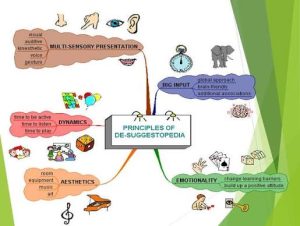
The background of English learning at the high school level is often colored by students’ affective barriers, such as language anxiety, fear of grammatical errors, and low confidence when actively participating in class. In the context of grade XI high school students, the burden of a curriculum that demands mastery of complex texts often exacerbates these psychological barriers, so that English learning achievement cannot develop optimally. The Suggestopedia method, developed by Georgi Lozanov, is a transformative pedagogical approach rooted in the principle of desuggestology—a concept that seeks to eliminate intuitive mental barriers and negative perceptions of students’ own learning capacity. Through the manipulation of a conducive learning environment, the use of classical or baroque music at a regular tempo (60 beats per minute), relaxation techniques, anxiety desuggestion, and the integration of drama and role-playing, Suggestopedia creates a subcontradictory learning atmosphere that stimulates long-term memory retention. In the context of modern education, the effectiveness of this method needs to be scientifically tested to measure the extent to which the elimination of emotional tension is able to boost students’ academic achievement in the linguistic realm.
Empirical research with quasi-experimental design involving control groups and experimental groups in grade XI high school students showed significant differences in English learning outcomes after the implementation of Suggestopedia. The experimental group taught using the Suggestopedia flow—including the presentation stage, first concert (reading the text to the music), the second concert (the reading of the text in a relaxed tone by the students), and elaboration—showed a much higher increase in the average post-test score than the control group taught with the conventional grammar-translation method. Analysis of statistical data through an independent sample t-test confirmed a p-value that was less than the significance level (), which means that the null hypothesis was rejected and the working hypothesis was accepted. This increase in learning achievement was not only limited to vocabulary acquisition in isolation, but also included reading comprehension and speaking fluency. These findings prove that the decrease in affective barrier is directly correlated with the efficiency of the brain’s cognitive processing in absorbing foreign language structures.
The main mechanism that explains the success of Suggestopedia lies in the simultaneous stimulation between the left and right hemispheres of the brain (whole-brain learning). When baroque music is played in the background, the student’s brain waves shift from the Alpha wave to the low Beta, a relaxed but focused situation that is ideal for the absorption of new information. In this condition, the working memory capacity is no longer burdened by the fear of being judged or judged by peers, but instead focuses entirely on the interpretation of the meaning and context of the language. Furthermore, the use of pseudo-names and role imagination in Suggestopedia activities allows grade XI students to experiment with English sentence structure without fear of losing face. This desuggestion effect effectively deconstructs the conventional limiting belief that “English is a complex and difficult subject”, and replaces it with the positive suggestion that language mastery is a natural, enjoyable, and achievable process for any individual.
Although Suggestopedia has proven to have a substantial positive impact on learning achievement, its implementation at the high school level still faces a number of practical challenges that require strategic adjustments. The need for special facilities such as quiet classrooms, soft lighting, comfortable seating, and quality audio facilities are often obstacles for schools with limited resources. In addition, the teacher’s preparation portion of designing highly suggestive materials and selecting the right songs requires additional pedagogical competence and creativity. Nevertheless, Suggestopedia’s flexibility allows educators to adapt its core elements—such as the use of instrumental music during reading sessions, positive visualization techniques, and indirect error correction—into the regular classroom without having to completely alter the school’s physical infrastructure. This pragmatic adaptation ensures that the psychological benefits of Suggestopedia can still be felt by students within the existing operational limits.
In conclusion, the Suggestopedia method has been shown to have a positive and significant impact on improving the English learning achievement of high school grade XI students through stress-free environmental conditioning and optimization of cognitive-affective function. The integration of aspects of art, music, and anxiety desuggestion has been shown to be effective in breaking the mental blockade that has been hindering students’ linguistic potential in the secondary school curriculum. The pedagogical implications of these findings confirm the importance of a paradigm shift in English language teaching: from an approach that focuses solely on memorizing rigid grammar formulas to a holistic approach that prioritizes the emotional well-being and psychological comfort of learners. For education practitioners and linguazona.com managers, the application and dissemination of Suggestopedia’s principles is expected to be a reference for updating teaching strategies that are innovative, humanist, and highly effective in improving English proficiency standards in Indonesia.
#suggestopedia
#georgilozanov
#ikafarihahhentihu